Turning real-world implementation into learning that can travel
Agricultural programmes are constantly making decisions in changing conditions. Yet the information needed to make those decisions can take time and resources to collect, analyse and return – sometimes arriving after the moment when it would have been most useful.

Agile Data set out to explore whether that distance could be shortened.
Could useful information be generated more quickly? Could it be generated more efficiently? And could more agile approaches maintain the validity needed for confident decision-making?
These questions placed time, cost and validity at the heart of the work.Agile Data was built through collaboration. Working with research, implementation, producer, technology and other partners across nine countries, COSA tested different approaches to collecting, interpreting and using information in real-world agricultural settings. These included mobile applications, WhatsApp, interactive voice response (IVR), computer-assisted telephone interviewing (CATI), and other digitally enabled and human-supported approaches.
Partners brought the local knowledge, implementation experience and perspectives needed to understand not only what happened, but why – helping approaches to be tested, adapted and understood in context.
The objective was never simply to digitise data collection or prove that one technology was better than another.
It was to understand whether different approaches could shorten the distance between what is happening in the field, what we can learn from it, and what programmes and practitioners can do in response – while understanding the implications for time, cost and the quality of the evidence generated.
What emerged was not simply a story about faster data.
It was a much broader body of learning about what it takes for data to become useful in real-world implementation.
Time. Cost. Validity.
Agile Data began with a practical challenge familiar to many organisations working in agriculture and development: generating robust evidence can require significant time, resources and effort.
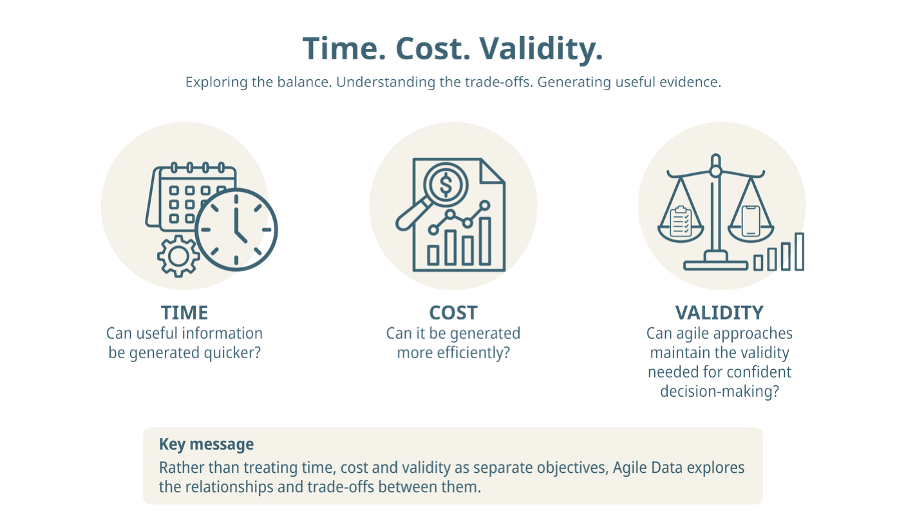
Digital and remotely enabled approaches create opportunities to change that equation. But they also raise important questions.
Getting information faster is valuable – but faster is not necessarily better if the information is not sufficiently reliable or useful for the decision being made.
Reducing the cost of data collection matters – but lower collection costs may come with different requirements and trade-offs around participation, coverage, support and data quality.
And validity remains fundamental. The question is not simply whether data can be collected digitally, but whether we can have sufficient confidence in what it tells us – and understand the limitations of the approach used.
So rather than treating time, cost and validity as separate objectives, Agile Data explored the relationships and trade-offs between them.
And it was through implementation that many of the most important lessons became visible.
Learning through implementation
Some things can be tested through research design. Others only become apparent when an approach meets the realities of implementation.
Different countries, value chains, farmer populations and operating environments allowed Agile Data to see how approaches performed under different conditions: where people engaged and where they did not; where particular channels worked well; where additional human support mattered; how quickly useful information could be generated; and where implementation challenged initial assumptions.
This is why the experience across nine countries matters.
Its value is not simply geographic reach. Different contexts allow us to ask more useful questions: Do the same patterns recur? Where do they differ? And what can those differences teach us?
Over time, this created a body of learning made up not only of datasets and formal research, but also of implementation experience, cases, observations, adaptations and the perspectives of the farmers, practitioners and partners involved.
Throughout this series, we will bring these different forms of evidence and experience together to explore where findings converge, where they differ, and what others can learn from them.

What did we learn?
The work generated many findings and lessons. As Agile Data draws to a close, COSA is bringing this wider body of evidence together.
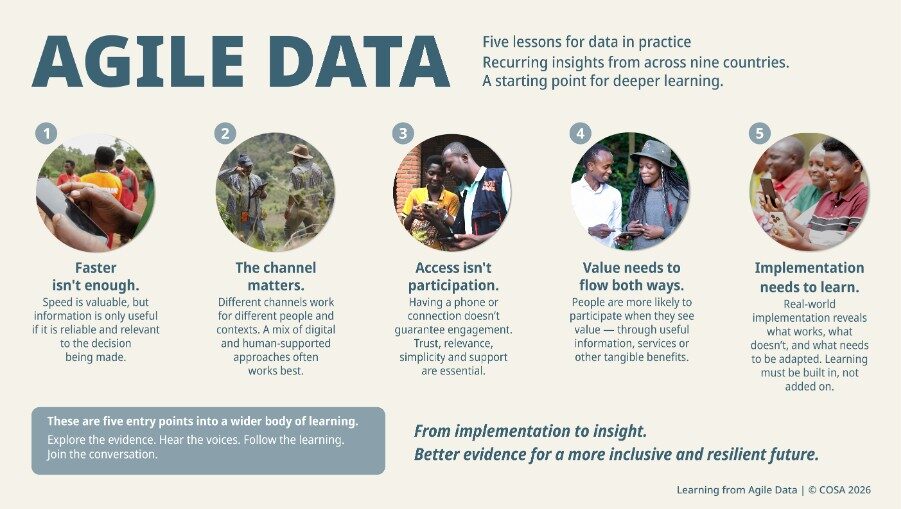
We are beginning by foregrounding five lessons that recur across the work and provide useful entry points into the wider learning.
1. Faster isn’t enough
Timeliness matters.
The sooner programmes can understand what is happening, the sooner they may be able to respond. But speed alone is not the objective.
Information still needs to be sufficiently useful and credible for the decision at hand. And collecting data more quickly creates little value if the information then sits unused, if it is not reliable enough to act on, or does not answer the question decision-makers need to address.
The more important opportunity is therefore not simply to make data collection faster, but to shorten the distance between: what is happening → what we know → what we decide → what we do.
That shifts the conversation from faster data to more responsive decision-making.
2. The channel matters
Agile Data explored different ways of reaching and engaging farmers and other participants.
One of the clearest lessons is that there is no single “best” channel.
Apps, WhatsApp, IVR, telephone interviewing and human-supported approaches each create different possibilities and constraints. Their performance can depend on the task, the frequency of interaction, connectivity, language, familiarity with technology, the complexity of the questions being asked and the context in which people are participating.
Channel choice can also affect time, cost and validity.
A channel that is quick and inexpensive may not reach everyone equally. Another may require more support but enable a different kind of engagement or information.
So the question becomes less: Which technology is best? and more: What works, for whom, for what purpose, and under what conditions?
3. Access isn’t participation
Making a digital tool or channel available does not mean that people can – or will – participate effectively.
Connectivity matters. So do language, literacy, confidence, trust, access to devices, familiarity with technology and local circumstances.
Human support can matter too.
This distinction is particularly important for evidence. If some groups are less able or willing to participate through a particular channel, the resulting data may tell us as much about who the approach was able to reach as about the population we intended to understand.
Participation therefore cannot be treated simply as a communications or inclusion issue.
It can affect the evidence itself.
Access can be provided. Participation has to be designed for.
4. Value needs to flow both ways
Too often, people participating in data collection experience the process primarily as extraction: questions are asked, information leaves, and little comes back.
Agile Data points towards a more reciprocal relationship.
When farmers contribute their time, experience and information, there is an opportunity for useful value to return – whether as insights, guidance, feedback or information they can understand and use.
This does not mean every interaction must produce an immediate benefit. But it does mean asking a different design question: What does the participant get back?
Making value visible can strengthen the relevance of participation and help move data systems away from seeing farmers simply as sources of information.
The flow of information should not only move from the farmer to the programme.
Where possible, it should also move back towards the farmer in useful form.
5. Implementation needs to learn
Not everything can be known or designed correctly at the outset.
Real-world implementation reveals friction, behaviour, contextual differences and unexpected results that may not be visible during programme design.
That makes implementation itself an important source of evidence.
The ability to observe what is happening, analyse the signals, make changes and see what happens next allows programmes to become more responsive as they operate.
In simple terms: Observe → Learn → Adapt
This does not replace rigorous research or evaluation. It complements them by creating a faster learning loop within implementation.
And it changes the role of data.
Rather than being used only to assess what happened after implementation, data can also help programmes learn while implementation is happening.
Different settings. Recurring signals. Important differences.
These five lessons are not intended as universal rules.
Context matters.
One of the opportunities created by Agile Data’s experience across different settings is the ability to examine where similar signals appear – and where they do not.
A channel that works well in one context may perform differently elsewhere. A cost advantage may depend on the type of information being collected.
Participation patterns may change according to connectivity, language, gender, trust or local communication practices. And the appropriate balance between digital interaction and human support may vary considerably.
Those differences are not noise around the evidence.
They are part of the learning.
Throughout this series, we will therefore return to a simple lens: Different settings. Recurring signals. Important differences.
Rather than asking whether one model works everywhere, we want to understand what appears to travel, what remains context-specific, and what practitioners should consider when making their own choices.
From findings to shared knowledge
As Agile Data draws to a close, the objective is not simply to publish a final set of project outputs.
COSA is formalising, curating and translating the learning generated through the work so that it remains accessible and useful beyond the life of the project.
Research and evidence are being developed into journal articles, learning briefs, case studies and practical guidance. The same learning is being translated into visual explainers, videos, short articles, animations, audio and other formats so that different audiences can engage with it in different ways.
The Agile Data Learning Library will provide an enduring home for this body of knowledge – bringing together evidence, experiences and practical resources rather than allowing them to disappear at project close.
And the learning will not only be presented by COSA.
The farmers, practitioners, researchers and partner organisations involved in the work helped generate, test and challenge it. Their perspectives will therefore be an important part of how the story is told.
As we explore each of the five foregrounded lessons, we will bring together evidence, implementation experience and partner voices – and invite the wider community to contribute its own experience.
Carrying the learning forward
The work has answered some questions. It has sharpened others. And in some cases, what we learned has changed the questions we think programmes should be asking.
Over the coming weeks, we will unpack these five lessons – and others emerging from the wider body of work – through the evidence, cases and voices behind them.
We will ask how time, cost and validity played out across different approaches and contexts. We will look at where experiences converge and where they differ. And we will invite the people who helped generate the learning, as well as the wider community, to challenge, add to and reflect on what it means for practice.
Through the Agile Data Community of Practice, that conversation will continue: What have we learned? What holds across different contexts? What remains unresolved? And what should programmes carry forward? The project is concluding.
The learning is there to be used – and the conversation continues.
Agile Data was built through collaboration
The learning shared in this series draws on the contributions and experience of farmers, producer organisations, implementation partners, researchers, technology partners and other organisations involved in Agile Data across different countries and contexts.
With thanks to the partners who made this work and learning possible.

The Agile Data Approaches and Innovations for Monitoring (ADAIM) was supported by the Gates Foundation.